2026-01-03
time to start your own book
Continuing on the topic of new year new me, let's have a chat about writing.
I think, it's time you wrote a book.
writing is hard
I'd say by my estimation most people suck at writing. That's partially why I started this blog, to get better. For a native English speaker, I think I'm pretty average.
Delivering ideas is probably one of the most important things you can do in life. In a previous career a good portion of what I did was delivering ideas, mostly via IM and email. Occasionally on a phone call. I'm cheating a little though, most of that 'delivering ideas' was pointing at charts, which was good because people are typically better visual learners than text learners.
I'll give an example.
Do you know what the approximate difference between a millionaire and a billionaire is?

It's about a billion dollars.
people are bad at reading
I mean, it's basic maths. Of course a million, billion and gorillian dolans are different.
The point I'm trying to make is that it's really hard to convey things with just words, sometimes. Getting your message across in only words. No body language, no visual aids, is very hard.
Because that's the case, one should practice with themselves before they begin writing for an audience. Think of it like public speaking in a mirror. Writing is, in my opinion, the most difficult of the art forms. Of course, you can go straight for an audience. But I'm also a big believer in learning things yourself - being self-sufficient in that aspect. Be the guinea pig before finding a guinea pig1.
It's with that in mind that I believe that in the next year if you're looking to level up your ability to generate ideas, connect concepts, deliver a message and in general feel 'smarter' (however you define that) you should begin writing your own book. A book that is being written to yourself.
writing your own 'book'
Is the bible a book? Or a collection of books? How about a number of pages clipped together with sudoku puzzles?
I'm not going to argue the philosophy behind what a book is, but the loose definition I'll be using is a somewhat organised grouping of ideas, written down for future reading. For some people that might mean a journal. For others, it's a blog (me). With some people it might not even be that, simple class notes are enough to suffice. Maybe it's simply a spreadsheet with numbers.
Whatever it may be, write something to yourself. Make sure you read it again. Set a reminder. And - this is probably the most important part - have some sort of organisational system. You don't need to have the organisational skills of a career librarian. Just have something, so you know the loose structure of your 'book'.
why your 'book' is good
Believe it or not, your mind, sanity and memory are limited resources2. Like the oil in the ground, money in your bank or the patience of your parents. Sometimes it may seem endless, my mind at 7am and 7pm are very different (Yes! I'm a morning person). In the morning it typically feels like I'm ready to sit three final exams back-to-back, by the afternoon I feel like a drooling toddler.
Whilst you have that drive, motivation and most importantly, creativity in the morning / afternoon / night / during the shower3, litres of digital ink should be spilled into your 'book'.
Write down thoughts, feelings, potential connections. Over time you'll begin noticing that various topics you write about will connect more than you realise. A (real) example was learning to play Catan. I was reading up on strategies to win and was thinking about why turns early on in a game are quick, with the speed of the game grinding to a slog an hour in. It was at that point that I noticed the time complexity (yes, from your DSA class4) was something like $O(n^n)$ given the increase in permutations of potential moves that can be taken as a game drags on.
I find myself going back and reading my book often. When I come across a new topic, I'll search certain key-words from that topic in my book. I sometimes get results. And those results illuminate connections for me, that would have previously gone unnoticed.
A great way to enable this is some form of linking or tagging system. I go into my own setup a bit more below.
my 'book'
I use Obsidian. It's great. It's simple, clean, and as complicated as you want it to be. I adore the linking system, and there are endless plugins for any sort of functionality you want. At the time of writing, there's over 2,700 directly linked in the application.

Should you use it? If you want. If you're just starting out, use something else open source, because Obsidian isn't. Some suggestions include Standard Notes and Joplin. I've used both before and think they're broadly acceptable if you're looking for the bare minimum. I've consciously made the decision to use Obsidian despite being closed source, simply because I find it so good. Plus, the output is simple .md files, so there's not much worry if Obsidian ceased to exist tomorrow.
If you don't need in-built cloud syncing, it's also free.
how i use my book
New topic? New chapter in the book.
Old topic? New page in a chapter.
Not sure? Into the inbox it goes, sort it out later.
There's a good web clipping extension for both Safari and Firefox I use when I want to save something for reading / note-taking later on. When I've saved a web clip, I always go back and re-read, paraphrase and condense the content. Think about it. Don't just blindly read it. Put your thoughts down. Why is it useful? Or not? What parallels can be drawn to other things you've recorded and thought about?
Some functionality that makes Obsidian special:
-
The linking system allows you to 'connect' notes like a Wikipedia article. Type
[[and start typing a word, you'll get a list of existing notes you can link to. Pick a 'topic' note for each topic and throw it into a folder. You aren't going to go back and read these 'topic' notes. They simply serve to link ideas together.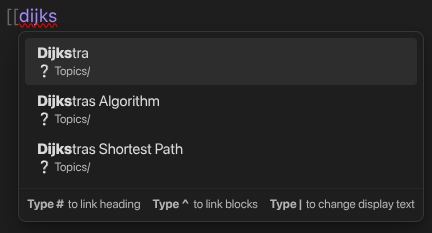
an example of linking to my 'topic' notes, stored in their own folder. -
Dataview is used to then show linked notes and ideas. Have a dataview set up for each note you make. You'll be able to see wherever else you've referenced it. The code block below gets put at the top of every note so that you can see all the notes that link to this particular note.
                    ```dataview
                    list from ""
                    where contains(file.outlinks, this.file.link)
                    ```
you can simply copy and paste this into any Obsidian note once you have the plugin installed. - Templater allows you set up templates for new notes. You can have it automatically trigger when making a new note in a folder. I have a template set for every time I create a new note, which includes the snippet above.
- List Callouts. This is a bit different, it's more because I'm a bit intense with my labelling and colouring, not necessary for most people.
- MathLive. Obsidian supports MathJax (like this blog) however this plugin makes actually typing math out significantly easier.
- Auto Link Title. Works great with web clips.
results
At this point you may be, fairly, questioning, "so?".
The TL;DR version is to read this article from the smart af Gregory Boltnick, who could use the idea of Tesla Coils to explain my thought process here, way better than I could ever put into words. Plus, he's an ex-Citadel PM so he's probably used to getting it right more often than he gets it wrong3.
It's actually where I got the inspiration to write this post.
I've felt far more engaged than I've ever felt before, whilst going through the process of writing my own book. I've always struggled with math classes but once putting my own advice into action, I've achieved better marks than I thought imagineable. That's not to say it's a shortcut to success. It's not. I just find abstract math relatively difficult, but once applied to CS concepts it begins to click for me. Unfortunately it's not typically taught that way.
Now when I take notes on topics, or think about things, I've got this framework constantly working in the back of my mind. I'm piecing things together and figuring out how pieces of the world fit. When I solve LeetCode problems, I'm able to go back and read the theory on why certain algorithms work. When I'm learning database schemas, I've now got this linked note on set theory to reflect back on. The examples go on indefinitely.
Gregory talks about reading books, but I take it a step further and think you should be writing books. To yourself.
give it a try
I hope I've been convincing enough to at least give this a try. You may keep it up, you may not. Chances are you already do something similar, probably unorganised. And that's okay.
Here's your motivation and reason to take it to the next level.
- ouzo
- I'm clearly not listening to my own advice here, posting publicly on a blog. Maybe listen to the message and not the message giver. ↩
- I'm typically a big believer in providing receipts and would link to an academic study for claims like this, but I don't think that's needed here. ↩
- Speech-to-text apps are helpful here. ↩
- Time and space complexity are ways to generically measure the performance of an algorithm, without regard for the type of hardware being used. DSA is an initialism for 'data structures and algorithms', a core course in any typical computer science degree. ↩
- Citadel is one of the largest and most profitable hedge funds in history, known for only hiring the best of the best. ↩